Choosing between acid-etched and sandblasted glass affects privacy, maintenance, appearance, and long-term performance. What are the benefits of acid-etched glass vs. sandblasted glass? The answer depends on where the glass will be installed, how often it will be touched, and the finish required.
Grand View Research’s Decorative Glass Market Report identifies privacy, architectural design, and interior renovation as major demand drivers. The U.S. Energy Information Administration also reports that lighting remains a significant part of commercial building energy use. These findings make glass selection more practical than decorative. A bright, diffused partition can soften glare, but it cannot solve every lighting problem.
Helen Sanders, Ph.D., a respected glass-industry technical expert, has said, “Glass performance is never just about the center-of-glass number.” Her point applies here. Surface texture changes cleaning behavior, fingerprints, visual softness, and perceived brightness. Acid-etched glass usually offers a more uniform finish and smoother surface. Sandblasted glass can create stronger texture and visual depth, but its microscopic surface may hold dust and oils more easily.
The difference becomes visible in a busy hallway. A handrail beside sandblasted glass may show dark contact marks. Acid-etched glass may clean faster, yet it can still reveal smears under direct sunlight. Neither option is perfect.
This guide compares seven practical considerations, including privacy, durability, cost, customization, maintenance, safety, and environmental impact. The goal is not to crown one finish universally. It is to help buyers choose with fewer assumptions and better evidence.
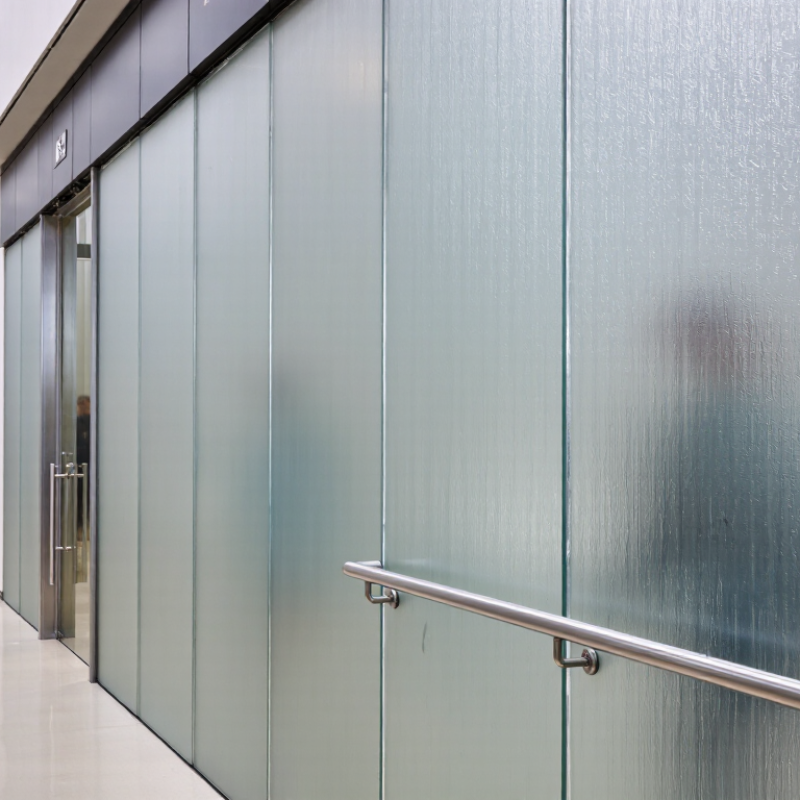
Define Acid-Etched and Sandblasted Glass by Process, Finish, and Maintenance
Acid-etched and sandblasted glass both diffuse light, but their surfaces behave differently. Acid etching uses chemicals to alter the glass surface. It usually creates a smoother, more uniform finish. Sandblasting drives abrasive particles against the glass. It often produces a deeper, more tactile texture. Tip one: confirm the process in writing. Tip two: request a full-size sample. Tip three: view it under daylight and artificial light. Small samples can hide uneven shading. The U.S. Department of Energy reports that windows can affect 25–30% of a building’s heating and cooling energy use. That figure concerns glazing performance, not texture, but it supports careful glass specification.
Maintenance can change the buying decision. Acid-etched glass generally resists visible fingerprints better. However, oily marks may still appear near handles and doors. Sandblasted glass can collect dust in its microscopic texture. Cleaning may require more frequent, gentle wiping. Tip four: ask whether the surface has a protective treatment. Tip five: confirm cleaner compatibility. Tip six: inspect edges, corners, and drilled areas. Tip seven: obtain written maintenance guidance. Avoid harsh pads and unapproved chemicals. A common mistake is choosing by appearance alone. I would not assume every etched surface cleans easily. Manufacturing quality, coating, location, and daily contact all matter. A test panel is inexpensive insurance.
Compare Visible Light Transmission, Haze, and Privacy Performance
Acid etched and sandblasted glass can look similar, but their optical performance often differs. Visible light transmission (VLT) depends on glass thickness, coating, and surface treatment. Published architectural glass data in the International Glazing Database, 2024 release, commonly shows translucent products ranging from about 70% to 90% VLT. These figures are product-specific, not universal.
Haze measures scattered transmitted light, not privacy by itself. ASTM D1003 provides a recognized haze-testing method, while ISO 9050 evaluates visible transmittance. Acid etched surfaces usually provide more consistent haze across large areas. Sandblasted glass may produce stronger diffusion, but uneven blasting can create visible patches. Privacy also changes with lighting. A bright room behind the glass may reveal silhouettes at night. A sample can mislead.
Tip 1: Request VLT and haze values from the same test report.
Tip 2: Compare samples under daylight and interior lighting.
Tip 3: Check the viewing distance, not only a close-up.
Tip 4: Ask whether the finish is uniform across full-size panels.
Tip 5: Inspect fingerprints and cleaning marks under angled light.
Tip 6: Test privacy with a moving person, not a still object.
Tip 7: Specify acceptable silhouette visibility in writing.
The National Fenestration Rating Council’s NFRC 300 procedure also supports consistent optical reporting for fenestration products. However, it does not replace a project-specific privacy mock-up. That extra check feels inconvenient, yet it often exposes the expensive assumption: higher haze does not always mean better privacy.
Apply OSHA’s 50 μg/m³ Silica Exposure Limit to Sandblasting Risks
When comparing acid-etched and sandblasted glass, buyers should examine airborne silica risk before choosing a finish. OSHA’s permissible exposure limit for respirable crystalline silica is 50 μg/m³, measured as an eight-hour time-weighted average. The action level is 25 μg/m³. These limits concern inhalable particles, not visible dust alone.
Ask how the glass is blasted, what abrasive is used, and whether the work occurs inside a sealed cabinet. Request the abrasive’s safety data sheet and recent exposure-monitoring records. Check for local exhaust ventilation, sealed doors, filtered airflow, and a documented cleaning method. Dry sweeping can put settled dust back into the air. It is a poor shortcut. Confirm that workers receive suitable respiratory protection, fit testing, training, and medical evaluation where required by the applicable OSHA standard. Acid etching usually avoids abrasive blasting, but its chemicals require separate ventilation and handling controls.
Do not assume a clean showroom proves a safe production process. I would also ask whether the finish is produced in-house or subcontracted, because control quality may change between facilities. A buyer’s practical checklist should include edge durability, uniform texture, maintenance needs, and the measured silica level. One detail is easy to miss: “dust-free” is not the same as “below 50 μg/m³.” If a supplier cannot explain its monitoring method, pause the purchase and seek an independent industrial-hygiene review. That hesitation may prevent an expensive mistake.
Verify Safety Glazing Through ANSI Z97.1 and 16 CFR 1201 Standards
When comparing acid-etched and sandblasted glass, verify safety glazing before judging surface appearance. Ask for the permanent safety mark, not only a sales sheet. The mark should identify the applicable standard, manufacturer code, and classification. Request the test report, production date, glass thickness, and treatment type. Do not guess.
ANSI Z97.1 classifies impact performance through two key levels. Class A requires a 400-foot-pound impact test, while Class B requires 150 foot-pounds. The U.S. Consumer Product Safety Commission’s 16 CFR 1201 rule uses Category I and Category II requirements, including 150 and 400 foot-pound impact levels. Confirm which category applies to the panel’s size and installation location. A decorative finish does not prove compliance.
Check whether the etched or blasted surface was applied before or after tempering. Confirm that drilling, cutting, and edgework were completed before heat treatment. Inspect corners, shower-door areas, sidelites, doors, and low-level glazing carefully. These locations deserve closer attention. Compare the actual marking with the supplier’s documentation. Keep photographs and records for installation review. I would not rely on appearance alone; even experienced buyers can miss a faded mark or an incorrect report. ANSI Z97.1 and 16 CFR 1201 provide measurable evidence, but only when the documents match the exact glass supplied.
Evaluate Thickness, Heat Treatment, and Durability Under ASTM C1036 and C1048
Acid etched and sandblasted glass can look similar under showroom lighting. Their working behavior differs. Acid etching creates a relatively uniform satin surface, while sandblasting leaves microscopic texture that may hold oils and dust. ASTM C1036 addresses flat-glass quality, thickness, and dimensional tolerances. It does not approve a thickness for every application. A 6 mm pane may suit a small interior screen, but a large door needs load, span, and edge conditions reviewed.
Tip: Confirm the nominal thickness, measured thickness, and panel dimensions before ordering. Ask for the ASTM C1036 inspection basis, not only a sample.
Heat treatment changes safety performance, not automatically surface durability. ASTM C1048 specifies minimum surface compression of 10,000 psi for fully tempered glass. Heat-strengthened glass generally falls between 3,500 and 7,500 psi. These figures matter near doors, partitions, and impact-prone areas. However, acid-etched and sandblasted finishes can still scratch, stain, or show fingerprints. Tempering does not make the finish scratch-proof. It is an easy assumption to challenge.
Tip: Request heat-treatment records and a fragmentation test report. Check whether cutting, drilling, or edgework occurred before treatment. One overlooked detail can cause rejection.
For durability, compare cleaning methods and mock-up results. The National Glass Association’s technical guidance repeatedly emphasizes compatible cleaning tools and early removal of construction debris. Use a soft cloth, clean water, and a neutral cleaner. Abrasive pads can polish unevenly across a sandblasted surface. I would also test the finish beside the frame, where silicone, dust, and hand contact collect. A small trial panel often reveals more than a polished brochure.
7 Tips for Acid-Etched vs Sandblasted Glass Buyers
Evaluate thickness, heat treatment, and durability under ASTM C1036 and ASTM C1048.
How to read the chart: Acid-etched and sandblasted glass can be specified in the same common nominal thickness categories. The surface finish does not determine the glass thickness; the project specification must separately identify thickness, heat-treatment condition, and finish.
ASTM context: ASTM C1036 addresses flat glass requirements, while ASTM C1048 addresses heat-treated flat glass, including heat-strengthened and fully tempered glass. Neither standard assigns a universal durability score to acid-etched or sandblasted finishes. Durability should therefore be verified through the selected glass thickness, heat-treatment condition, surface protection, cleaning method, and application environment.
Conclusion
Choosing between acid-etched and sandblasted glass requires more than comparing appearance. Acid etching uses controlled chemical treatment to create a smooth, uniform, satin-like finish, while sandblasting mechanically roughens the surface for a more textured look. Buyers should compare visible light transmission, haze, and privacy levels, since both finishes can diffuse light differently depending on depth and pattern. A key question is: What are the benefits of acid-etched glass vs. sandblasted glass? Acid-etched glass often offers easier cleaning and more consistent visual quality, while sandblasted glass can provide stronger texture and design flexibility.
Safety and long-term performance are equally important. Sandblasting may generate respirable crystalline silica, so appropriate controls should be used to address the OSHA exposure limit of 50 μg/m³. Confirm that the selected panel meets safety-glazing requirements under ANSI Z97.1 and 16 CFR 1201. Finally, evaluate thickness, heat treatment, and durability according to ASTM C1036 and ASTM C1048 to ensure the glass is suitable for its intended application.

 DotView Glass